

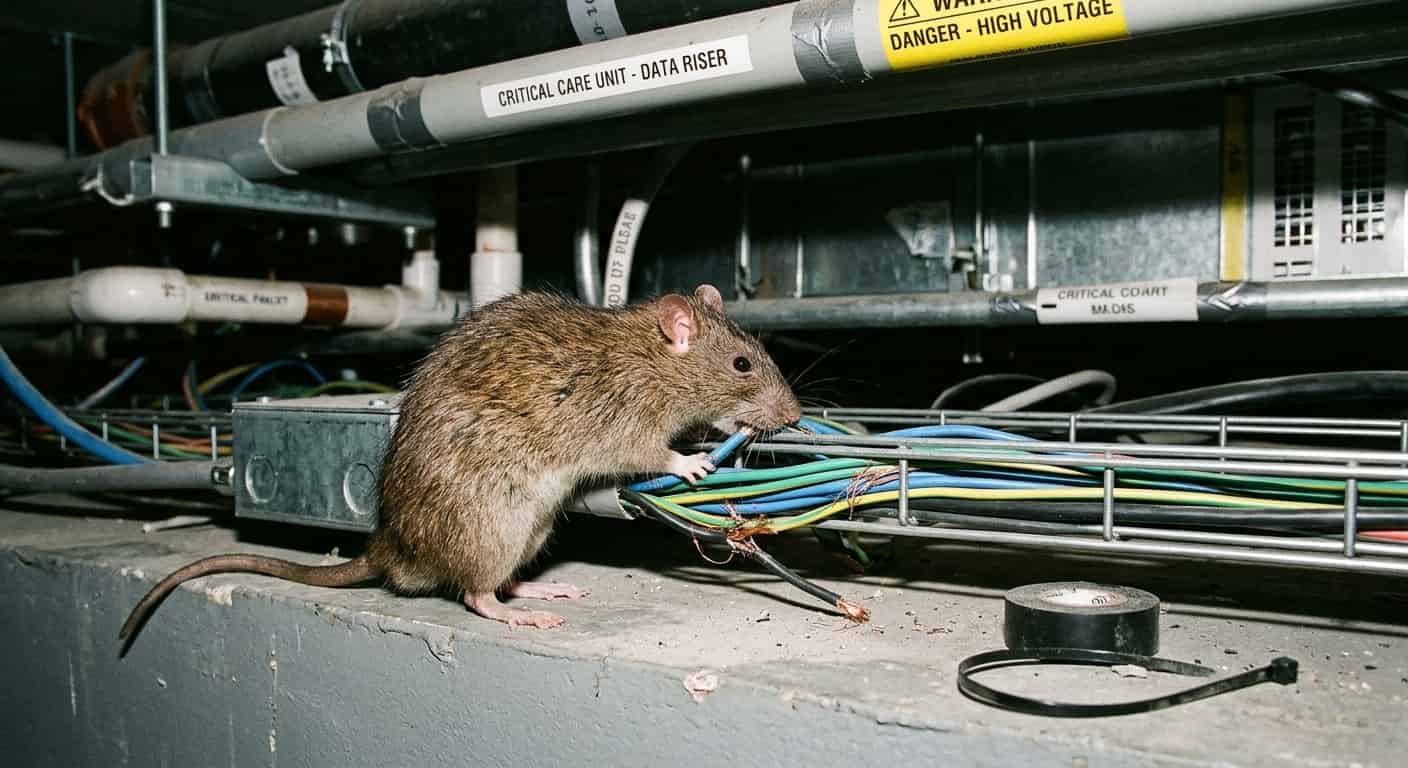
When most people think of rodents in a hospital, their first concern is infection. And rightly so — rats and mice are carriers of dangerous pathogens. But there is a second, less-discussed threat that hospital facility managers and healthcare administrators in NSW need to take seriously: rodents chewing through electrical wiring and medical equipment cables.
In a hospital environment, this is not just a maintenance issue. It is a patient safety crisis waiting to happen.
Why Rodents Target Electrical Wiring
To understand the threat, you first need to understand the biology behind it. Rodents — rats and mice alike — have incisor teeth that never stop growing. If left unchecked, their teeth would eventually prevent them from eating at all. To manage this, they gnaw constantly on whatever is available: timber, plastic, soft metal, and, critically, the insulation around electrical cables.
The plastic and rubber coating on electrical wiring provides exactly the right resistance and texture for a rodent to wear down its teeth. It is not a preference — it is a biological drive. And in a large, climate-controlled building like a hospital, with warm wall cavities, roof voids packed with cabling, and abundant food sources from kitchens and waste areas, rodents find near-perfect conditions to breed and thrive year-round.
The Stakes in a Hospital Are Uniquely High
In a residential or commercial office setting, chewed wiring means flickering lights, tripped circuit breakers, or the risk of an electrical fire. These are serious problems. But in a hospital, the consequences reach an entirely different level of severity.
1. Life-Critical Equipment Can Fail
Rodents have been documented chewing through cables connected to MRI scanners, CT machines, catheterisation lab (CathLab) equipment, ventilators, and patient monitoring systems. When wiring to these machines is damaged, the equipment can fail mid-procedure or lose calibration without any visible external sign. In an ICU or operating theatre, an unexpected equipment failure is not an inconvenience — it is a direct risk to a patient's life.
2. Power Failures in Sensitive Areas
Exposed wires resulting from rodent damage can cause short circuits that knock out power to entire wings of a hospital. While backup generators cover emergency power, many sensitive diagnostic and treatment systems require uninterrupted, stable power. A sudden fault can corrupt data, damage equipment, and disrupt care across multiple wards simultaneously.
3. Fire Risk in Wall and Ceiling Cavities
When a rodent strips the insulation from an electrical conductor, bare metal can arc against nearby materials — timber roof beams, accumulated nesting debris, or other cables. Hospitals are full of exactly the kind of hidden spaces where this can smoulder undetected for hours before ignition. In a building where patients cannot quickly self-evacuate, the consequences of a fire are catastrophic.
4. Contamination of Medical Supplies and Sterile Areas
Beyond wiring, rodents chew through packaging and insulation materials to build nests. In a hospital, this means sterile supplies, IV bags, dressing materials, and laboratory consumables are all at risk of contamination. Once a sterile item has been compromised by rodent contact — even indirect contact through droppings or urine nearby — it must be discarded entirely.
5. Insurance and Financial Exposure
The financial cost of rodent damage in hospitals extends well beyond the repair bill for chewed cables. Replacement of specialised medical equipment can run into hundreds of thousands of dollars. Operational downtime while equipment is repaired or replaced disrupts patient care and costs revenue. And critically, many insurance providers may not cover rodent-related damage if a facility cannot demonstrate that a proactive, documented pest management program was in place.
Why NSW Hospitals Are Particularly Vulnerable
Hospitals across New South Wales face specific pressures that make rodent management especially challenging.
Continuous foot traffic. Hospitals never close. Doors are opened thousands of times a day by staff, patients, visitors, and suppliers — each one a potential entry point for rodents moving along building perimeters.
Extensive food handling areas. Hospital kitchens, cafeterias, vending areas, and staff break rooms create a reliable, ongoing food source that attracts and sustains rodent populations within the building.
Complex, ageing infrastructure. Many NSW public hospitals operate in buildings with decades of accumulated infrastructure — wall cavities, sub-floor voids, and roof spaces that are difficult to inspect and provide ideal harbourage for rodents.
Urban rat populations. Sydney and other major NSW cities are home to established populations of both Norway rats (Rattus norvegicus), which favour basements, sub-floors, and drainage systems, and Roof rats (Rattus rattus), which are agile climbers that nest in ceilings, roof voids, and upper-floor wall cavities — precisely where hospital electrical cabling runs.
Regulatory Compliance: What NSW Healthcare Facilities Must Know
Healthcare facilities in Australia are held to a zero-tolerance standard on pests. The National Health and Medical Research Council (NHMRC) guidelines require strict sanitation and pest management protocols across all healthcare settings to uphold public health standards. Beyond these guidelines, NSW Health policies mandate that all public health facilities maintain environments that actively prevent pest harborage and infestation.
Crucially, compliance is not a one-time box to tick. Regulators and accreditation bodies expect:
- Documented, ongoing pest management programs with written service reports for every inspection and treatment visit Evidence of proactive prevention, not just reactive treatment after a sighting
- Pest-specific risk assessments for high-risk zones such as ICUs, operating theatres, sterile processing units, kitchens, and waste management areas
- Staff training records demonstrating that employees can identify and report early signs of pest activity
A single confirmed rodent sighting in an operating theatre or ICU — reported by a patient, visitor, or journalist — can trigger regulatory investigations, accreditation reviews, and significant reputational damage that takes years to recover from.
Early Warning Signs: What to Look For
One of the most dangerous aspects of rodent activity in hospitals is that the damage happens in hidden spaces, long before anyone sees a live animal. Facility managers and maintenance staff should be trained to watch for:
- Gnaw marks on cable conduits, junction boxes, or wall panels — often appearing as parallel grooves in plastic or rubber
- Scratch or scurrying sounds in roof voids or wall cavities, particularly at night when the building is quieter
- Droppings near cable trays, electrical switchboards, or under kitchen equipment
- Unexplained electrical faults — flickering lights, tripped breakers, or equipment malfunctions with no obvious mechanical cause
- Shredded insulation or paper materials in hidden areas, indicating active nesting
- Grease marks along walls and skirting boards, left by rodents repeatedly following the same travel routes
Any of these signs should be treated as an urgent call to action, not a matter to note in the next maintenance log.
Effective Commercial Pest Control Strategies for Hospitals
Managing rodents in a healthcare environment requires a fundamentally different approach to pest control than in a standard commercial building. The use of rodenticides must be carefully managed to avoid any risk of secondary poisoning to patients, visitors, or pets. Treatments must be odourless, non-disruptive, and safe in environments where immune-compromised patients are present.
A professional commercial pest control program for an NSW hospital should incorporate the following:
Comprehensive Site Inspection and Risk Assessment
Before any treatment begins, a licensed pest control technician should conduct a full site assessment — mapping entry points, identifying active harborage areas, locating cable runs and roof void access, and flagging high-risk zones. This creates the baseline for a targeted management plan rather than a generic spray-and-bait approach.
Physical Exclusion
The most effective long-term rodent control in any building is blocking the routes rodents use to enter and move around. This means:
- Sealing gaps around pipe penetrations, cable conduits, and air handling ducts
- Installing door sweeps on external access doors and loading dock entries
- Fitting mesh over roof vents and drainage openings
- Addressing landscaping near the building perimeter that provides cover for rodents approaching the structure
Tamper-Resistant Bait Station Networks
Where rodenticide bait is used, it must be placed in professionally installed, tamper-resistant bait stations positioned along known rodent travel routes — exterior perimeters, loading docks, sub-floor areas, and waste management zones. Stations must be mapped, numbered, and checked on a scheduled basis, with detailed records kept of bait consumption and any activity indicators.
Non-Toxic Monitoring and Smart Trapping
Increasingly, commercial pest control providers are deploying IoT-connected monitoring devices — smart sensors and electronic traps that detect and report rodent activity in real time. For hospitals, this technology is particularly valuable: it allows pest activity to be tracked in sensitive areas without the need for chemical treatments in those zones, and it provides continuous data that supports compliance documentation.
Integrated Pest Management (IPM) Planning
A hospital's pest control program should be built on IPM principles — combining physical exclusion, environmental management, monitoring, and targeted treatment. IPM reduces reliance on chemical applications, prioritises prevention, and produces the documented, auditable records that regulators and accreditation bodies expect.
Staff Education and Reporting Protocols
Pest control does not begin and end with the pest technician's visit. Hospital staff — from porters and kitchen workers to ward nurses and maintenance crews — are the eyes and ears of an effective program. Regular briefings on what to look for and how to report it can mean the difference between catching a rodent problem in its early stages and facing a full infestation.
The Cost of Inaction vs. the Value of a Proactive Program
Some hospital administrators view commercial pest control as a routine operating cost to be minimised. In a healthcare facility, this is a false economy. Consider the comparison:
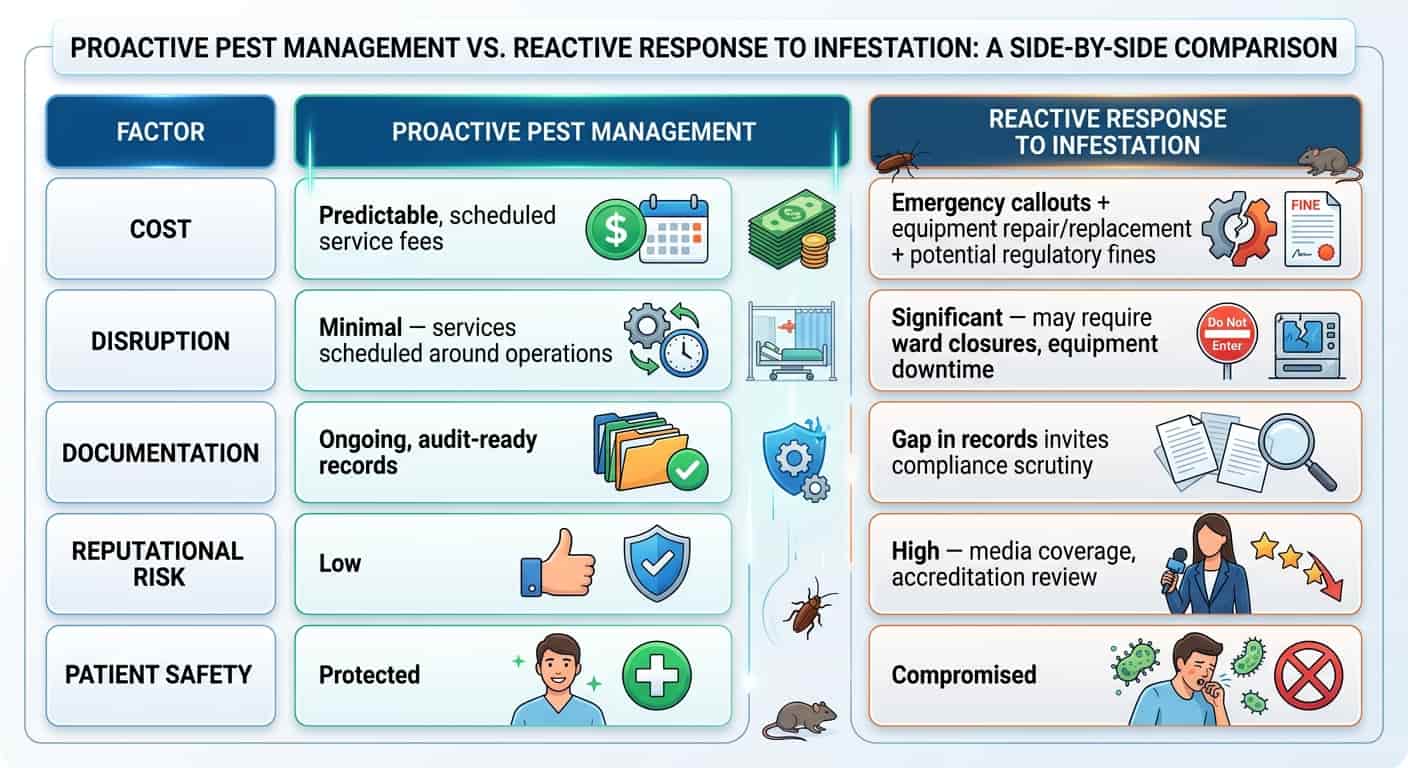
A well-structured commercial pest control program is not an expense — it is risk management.
How Safe Spray Pest Control Supports NSW Healthcare Facilities
Safe Spray Pest Control provides commercial pest control services tailored to the unique requirements of healthcare environments across NSW. Our hospital pest management programs are built around:
- Licensed, experienced technicians trained in healthcare-specific pest control protocols
- Complete service documentation for every visit — technician notes, treatment records, and bait station maps to support compliance with NSW Health and NHMRC requirements
- Flexible scheduling to minimise disruption to clinical operations
- Tailored IPM programs covering rodents, cockroaches, flies, and other healthcare pests across your full facility
If your hospital, aged care facility, clinic, or medical centre in NSW does not have a current, documented commercial pest control program in place — or if you have concerns about rodent activity near critical infrastructure — contact Safe Spray today for a confidential site assessment.
Don't wait for a fault in your wiring or a sighting in your ICU to take action. Call Safe Spray Pest Control and protect your facility, your patients, and your staff. Call 1300 562 053